
Dec: The Dog, the Rat and the Man in the Van – A Christmas Short Story
© Jane Harvey-Berrick
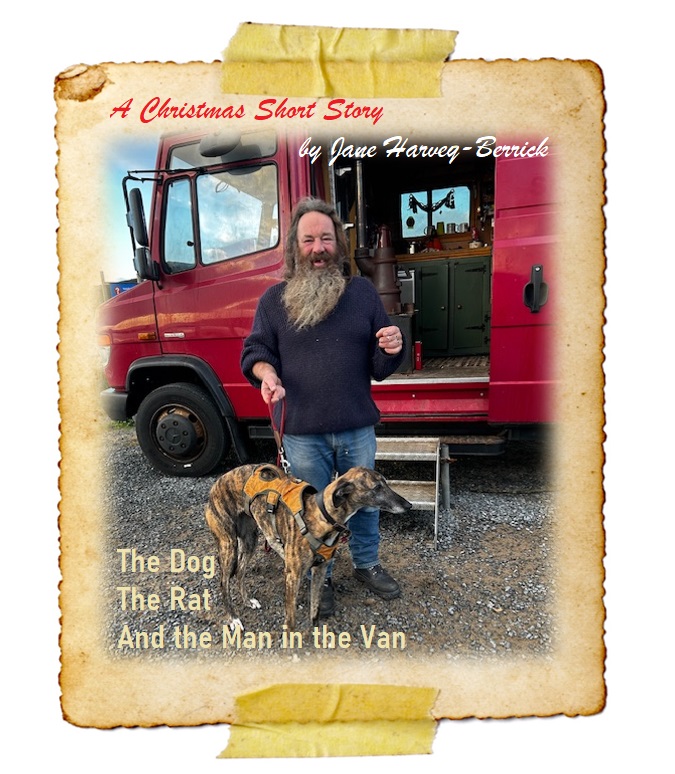
In the days when plague stalked the land and people hid behind their front doors, Bob bought a van.
It wasn’t a shiny new van, but old and pre-loved, if you like. And Bob did like it – he loved his van, and lavished every attention on it, turning it into a beautiful home, a tiny land-yacht with hand-crafted wooden cabinets, a large and comfortable bed, and a stove that would heat it with a coffee pot that he’d salvaged from an old steam train.
“When we can travel again,” he said to his beloved, “we’ll travel all over the country and go wherever you want to go.”
But plague doesn’t care for promises, and his beloved was swept away, as so many were in those days, and all Bob had left was his van.
So, one day, when the world and its woes began to heal, Bob climbed into his van and decided to do the long-planned travelling alone. Although he wasn’t really alone because happy memories nudged him, reminding him that there are good things and good people and good places in the world.
He hadn’t driven very far, when something just beyond the window, in the hedgerow, something strange caught his eye, his mind nudging him again. Bob had learned to pay attention to those gently nudges.
At the side of the road, was a puppy, trembling and afraid, her gangly legs and skinny body telling her own sad story.
“Who do you belong to, little lass?” he asked, scratching his beard.
The puppy looked at him with her soft brown eyes, still too young to know that sometimes good things happened when you most needed them.
The puppy was far from anywhere, far from any buildings or houses, far from anywhere she might call home. So, Bob picked her up and took her with him.
“Now what shall I call you? Spotty? Dotty? Pixie? Dixie?”
Her ears perked up.
“Dixie? Is that what you like?”
And in that moment, Bob was no longer ‘I’ but ‘we’.
Then he drove and drove and drove until he ran out of road and ran out of land, parking his van at the beach and staring out at the wide horizon beyond.
He climbed out, Dixie at his side, feeling the wind on his face and the scent of salt in the air.
“Yes,” he said. “This is right. This feels like home. What do you say, Miss Dixie?”
Dixie nudged his hand with her head as if to say, Yes, let’s make this our home.
Bob the beard’s broken heart began to mend, although you wouldn’t know he had a broken heart if you met him. He chose to look at life through rose-tinted spectacles and see the good in everyone and see the wonderful things that still existed in the world even though his dear, darling wife was not beside him.
He didn’t look like anyone else you have ever met. He was not a tall man but he was strong and well made, missing his two front teeth in a long-ago bar fight that should never have happened in the first place, when he was young and foolish, and caught between two men with very poor aims. He had long, wiry hair, and a long wiry beard that he sometimes plaited, and he was halfway between a hobbit and a pirate, although his feet were not particularly hairy.
And he lived happily in his van by the sea, with Dixie at his side, just the two of them.
One night, Bob had trouble sleeping. That happens sometimes when you have lived a long life, the memories crowd your mind, and all those conversations replaying themselves can be very noisy.
It didn’t help either that Dixie was scratching, her paws tapping against the side of the van as she dreamed her doggy dreams.
Scratch, scratch, tip, tap.
“Dixie! You’re keeping me awake,” huffed Bob.
She opened one eye and gave him an imperious look, because greyhounds are the princelings of the canine world, and don’t suffer fools. Having made her point, she closed her eye and went back to sleep.
Scratch, scratch, tip, tap.
And Bob realised that it wasn’t Dixie who was making the noise. But he couldn’t work out where it was coming from either.
Until the next morning…
…when he found a trail of crumbs coming from the packet of Custard Creams that he’d been saving for a special occasion.
And that was when he realised that a rat had come to live with them in the van. Bob wasn’t very happy about this. To be fair, not many people like rats, and the only time they’ve had a good press is when Kenneth Grahame wrote about them in The Wind in the Willows (although Ratty was really a water vole, which is not quite the same thing at all…)
But he did think it was strange that Dixie didn’t seem to mind the rat. Shouldn’t she be earning her keep by chasing away creatures with small, furry bottoms?
But she didn’t. Dixie ignored the rat.
So, Bob named him Ratty. Because what else would you call a rat to whom you haven’t been introduced?
Other people, however, were not as tolerant. Bob had many friends. With his soft Derbyshire accent, shaped by the peaks and valleys of the county he came from, deep in the heart of Britain, everybody loved Bob. He was a white knight in rusty armour with a kind word and a helping hand for all.
“You must catch the rat!” said one friend.
“No, you must kill it!” said another.
“Rats are dirty!” said a third. “They carry disease and will make you ill! Rats will bring back the plague!”
“Kill the rat! Kill the rat! Kill the rat!”
And one of them handed him a tin of rat poison.
With a heavy heart, Bob decided that they were right, and the rat ought to move out. He didn’t want to kill it, but he couldn’t catch it either.
So, that night, he put out a Custard Cream biscuit (because it was the rat’s favourite and even a condemned rat should have a good last meal), laced with poison, and left it on the driver’s seat of his van.
All night, Bob could hardly sleep, fretting with what he’d done to Ratty.
By now, the weather had turned colder, the season of towering skies and roaring seas was upon them, which was perhaps why the rat had searched for shelter in the first place, and even though Bob loved the wind in his face, the taste of salt-spray on his lips, and the wide, empty beaches, some old rats feel the cold.
With his heart thumping loudly, Bob peered over at the driver’s seat, and his eyes filled with tears. The Custard Cream lay untouched on the driver’s seat, not a single nibble mark marring its surface.
And he took the biscuit, wrapped it tightly, and threw it in the rubbish.
His friends weren’t happy. Surely that rat must die!
“Perhaps he won’t come back again,” Bob mumbled. “Perhaps I’ve scared him off.”
But on Christmas Eve, the rat did come back.
Scratch, scratch, tip, tap.
Dixie opened one eye and yawned, and Bob opened both eyes and smiled.
“Welcome back, Ratty,” he said.
But in the morning, when he peered over at the driver’s seat, he could not believe his eyes. There, on the worn leather was a beautiful, perfect, gold doubloon – hundreds of years old: treasure from a long-lost galleon.
Bob stared at it, hardly daring to believe his eyes. He picked it up, smooth and warm in the palm of his hand, trying to make out the worn writing in a foreign tongue.
“It’s a Christmas miracle,” he said, and Dixie woofed in agreement.
Bob couldn’t wait to share the good news with his friends.
“That’s amazing!” said one.
“Incredible!” said another.
“What a clever rat,” said a third. “Thank goodness I told you not to kill it. Perhaps it will bring you another gold doubloon.”
“Save the rat! Save the rat! Save the rat!”
The rat was a wise old rat and he never did bring the man another gold doubloon, if indeed they were anymore, because nobody ever found them, and the rat never said, but he lived contentedly with warmth and companionship for the rest of his days.
THE END
I hope you enjoyed this, based on a true story!
Merry Christmas to you all, and wishing you a healthy and happy 2025.